Seoul Subway Guide 2026: Fares, Cards, Lines and How to Ride

This guide contains affiliate links to Trip.com. If you book through them, Korea Local Guide may earn a commission at no extra cost to you. It does not change what is recommended or the order of the route.
I take the Seoul subway almost every day. It is cheap, fast, spotless, and it has Wi-Fi and heated seats in winter. Station announcements come in Korean, English, Chinese and Japanese.
Still, visitors get stuck on the same things. They buy a single ticket at every ride, trust Google Maps, or come out of the wrong exit and walk ten minutes the wrong way. This guide fixes those.
Checked on October 28, 2026. Fares are from 2026 guides that cite the Seoul city government. Pass prices change, so check before you buy.
How much is the Seoul subway?
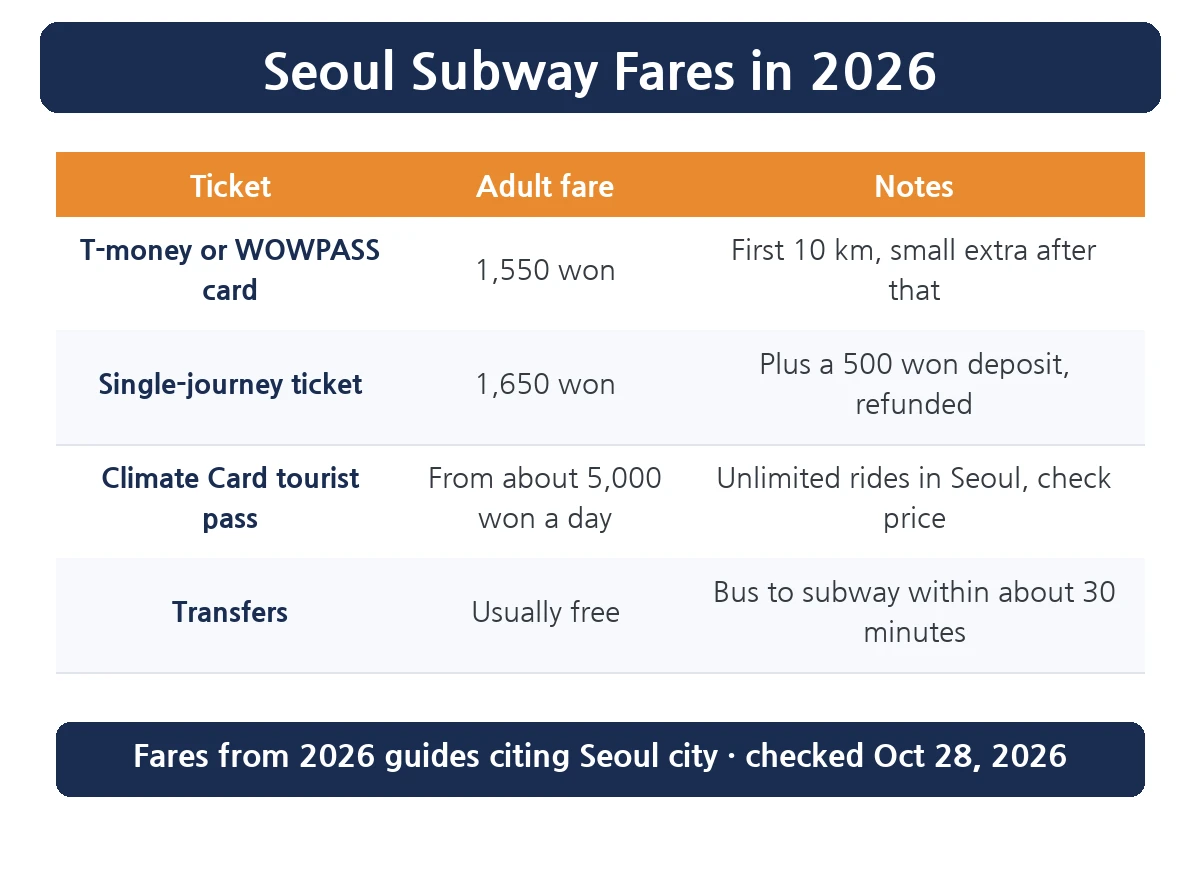
In 2026 the adult base fare is 1,550 won with a transit card, for the first 10 km. Longer trips add a small amount. A paper single-journey ticket costs 1,650 won plus a 500 won deposit, which you get back at a refund machine when you return the card.
Single tickets are a hassle. You queue at a machine every ride. Get a card on your first day.
Which card should you get?
- T-money: the standard card. Buy it at a convenience store or station machine, top up with cash, tap on every subway, bus and many taxis. See our T-money guide.
- WOWPASS: a prepaid card for tourists that you top up with foreign currency or a foreign card, and it works as a T-money card for transport. Good if you do not want to carry won.
- Climate Card tourist pass: unlimited rides on Seoul subway and city buses for a set number of days. When Seoul launched it in 2024, the 1-day pass was 5,000 won and the 7-day pass 20,000 won, plus the card itself. Check the current price; it only pays off if you ride a lot.
If you land at Incheon, you can pick up a T-money card at the airport and ride straight into the city on AREX.
How to ride, step by step

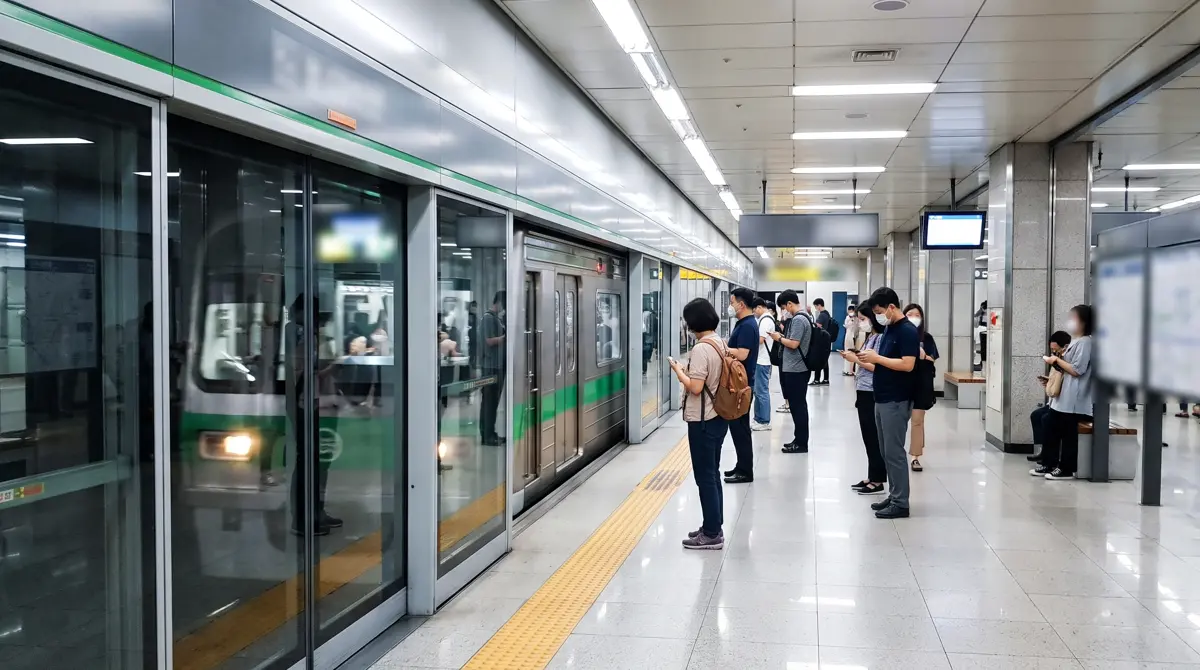
The system is simple once you know that direction is shown by the last station on the line, not by north or south. Your map app tells you which direction to take. Platforms have screen doors, and trains come every few minutes at busy times.
Always tap out at the gate when you leave. If you forget, the system charges you extra the next time you tap.
The lines you will use most

Line 2, the green one, is a loop and links Hongdae, City Hall, Gangnam and Jamsil. Line 4 runs through Seoul Station, Myeongdong and Dongdaemun. Line 3 gets you to Gyeongbokgung and Anguk for Bukchon Hanok Village.
Line 9 has express trains, marked in red on screens, that skip stations. Check before you board, or you may fly past your stop. The airport railroad, AREX, connects Incheon and Gimpo airports to Seoul Station. See our Incheon Airport to Seoul guide.
Which app to use
Do not rely on Google Maps here. It does not give full walking directions in Korea, and transit results can be incomplete. Use Naver Map or KakaoMap. Both have English, show the fastest car to board for transfers, and tell you which exit number to use. Read our Naver Map in English guide to set it up.
These apps need mobile data. Set up a Korea eSIM before you land.
Transfers, exits and hours
Transfers
Transfers inside the subway are free as long as you do not pass through the gates. Transfers between subway and bus are also free or cheap if you tap the same card within a short time, usually about 30 minutes. Transfer corridors at big stations can be long, so allow five minutes.
Exits
Big stations have ten or more exits, and they can be a few hundred meters apart. Your map app shows the right exit number. Yellow signs near the gates list the landmarks at each exit.
Hours
Trains run from about 5:30 a.m. until around midnight, and last trains differ by line and direction. If you are out late, check the last train in your app before 11 p.m. After that, it is a taxi. See our taxi app guide.
Subway etiquette
- Let people off before you get on
- Keep calls short and your voice low
- Leave the pink seats for pregnant women
- Leave the end seats for older people, even when the car is empty
- Wear your backpack on your front when it is crowded
Large suitcases are allowed, but rush hours, about 7 to 9 a.m. and 6 to 8 p.m., are packed. If you are moving between hotels, our luggage storage guide has better options.
Checklist
- Get a T-money card or WOWPASS on day one
- Use Naver Map or KakaoMap, not Google Maps
- Note your exit number before you tap out
- Watch for express trains on Line 9
- Check the last train before 11 p.m.
FAQ
How much is a subway ride in Seoul?
1,550 won for an adult with a transit card for the first 10 km in 2026, a little more for longer trips. A paper ticket is 1,650 won plus a refundable 500 won deposit.
Can I use a credit card on the Seoul subway?
Do not count on it. Most visitors use T-money or WOWPASS, and you cannot top up T-money with a card at station machines.
Is the Seoul subway easy for tourists?
Yes. Signs and announcements are in English, and stations are numbered. The main challenges are long transfers and choosing the right exit.
What time does the Seoul subway close?
Trains run until around midnight, but last trains differ by line and direction. Check in Naver Map or KakaoMap.
Is there a day pass for the Seoul subway?
Yes, the Climate Card tourist pass gives unlimited rides for one or more days. Check the current price before buying.
The short version
Get a T-money card or WOWPASS, plan routes in Naver Map or KakaoMap, follow the line color and the last station name, tap in and tap out, and pick your exit before you leave the gates. A ride costs 1,550 won. Check the last train before 11 p.m. For your first ride from the airport, see our Gimpo Airport to Seoul guide.